A Journey Through Bengal's Most Storied Landscape
Within a 20-kilometre radius of Baharampur lies one of India's densest concentrations of Mughal, Nawabi, and colonial-era heritage. Whether you're an architecture enthusiast, a history scholar, or a curious traveller, these monuments will leave you profoundly moved.
The Murshidabad heritage circuit, anchored by Baharampur as its modern hub, encompasses dozens of significant monuments spanning more than three centuries of history. The Archaeological Survey of India (ASI) protects many of these sites, but an equal number remain in the care of local communities, religious trusts, and private families who have maintained them across generations. Together, they form a living museum of extraordinary scope — one that rewards slow, attentive exploration far more richly than a hurried day-trip.
What makes Baharampur's heritage landscape exceptional is not merely the number or age of its monuments, but their extraordinary diversity. Within a single day's journey, a traveller can move from a Mughal mosque of austere grandeur to a neoclassical palace of Italianate elegance, from a crumbling Nawabi garden tomb to a British-era barracks that witnessed the opening shots of the Indian Rebellion of 1857. This juxtaposition of civilisations — Islamic, Hindu, and European — compressed into a small geographic space is unique in all of India.
Hazarduari Palace
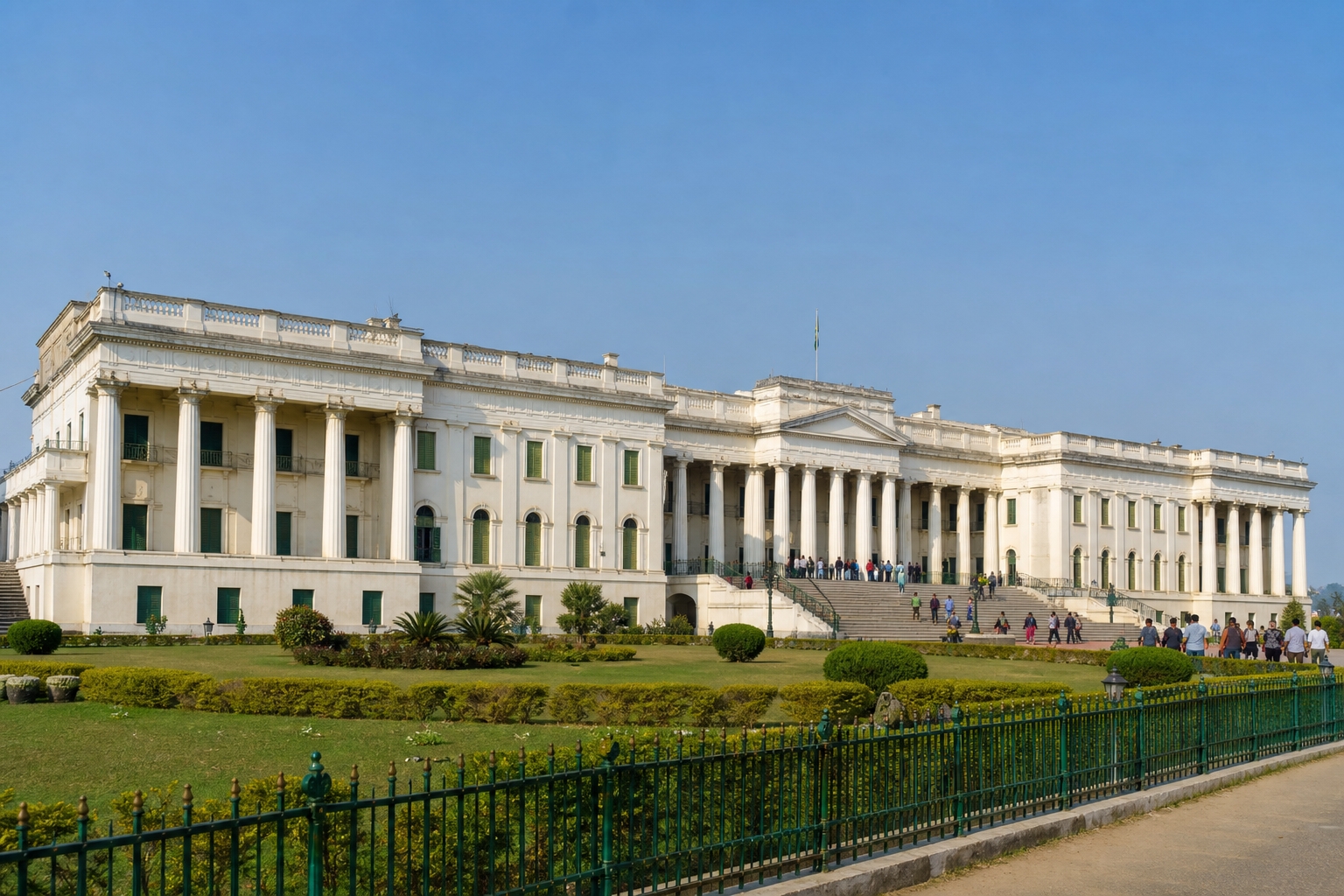
The name Hazarduari — "Palace of a Thousand Doors" — barely hints at the grandeur within. Commissioned by the Nawab of Bengal Nazim Humayun Jah and designed by Colonel Duncan McLeod of the Bengal Engineers, this magnificent neoclassical structure was completed in 1837. The palace stands three storeys tall with 114 rooms, 8 galleries, and its celebrated 1,000 doors (of which 900 are real and 100 are false, designed to confuse potential assassins).
Today operated as a museum by the Archaeological Survey of India, the palace houses one of the finest collections of Nawabi-era artefacts in the country: an armoury of swords, shields, firearms, and cannon; a portrait gallery of Bengal's Nawabs and British governors; ornate palanquins; Chinese and European porcelain; rare manuscripts and farmans (royal decrees) bearing the seals of Mughal emperors; and the personal possessions of successive Nawabs of Bengal.
What to See Inside Hazarduari Palace
The ground floor of the palace is dedicated to the armoury — a jaw-dropping collection of weapons spanning five centuries. Here, you'll find a 14th-century sword reputed to have belonged to the legendary warrior Pratap Aditya, alongside jewel-encrusted daggers, European flintlock pistols, Persian chain-mail armour, and enormous bronze cannon cast during the reign of Siraj ud-Daulah. The sheer density and quality of the collection reflects the military might once wielded by the Nawabs of Bengal.
The first floor houses the portrait gallery, whose walls are lined with life-size oil paintings of every Nawab of Bengal from Murshid Quli Khan to the last Nawab, Nazim Mansur Ali Khan Feradun Jah. Many of these portraits were commissioned from European artists during the colonial period, creating a fascinating visual record of cultural exchange. Also on this floor are exquisite examples of Murshidabad ivory carving — a craft for which the city was once world-famous — including miniature reproductions of Hazarduari itself carved from a single elephant tusk.
The second floor contains personal items of extraordinary intimacy: Siraj ud-Daulah's battle robe, still pierced by the bullet that killed him; personal correspondence between the Nawabs and British administrators; rare Quran manuscripts illuminated with gold leaf; and the silver-inlaid throne used by the Nawabs during formal durbars. The view from the upper-floor windows over the Imambara complex and the Bhagirathi beyond is alone worth the admission price.
Adjacent to the palace stands the Imambara Nizamat — the two buildings together form the heart of what many consider the greatest concentration of Nawabi heritage in South Asia. The palace's vast lawns, once the site of grand durbars attended by thousands, now host a pleasant garden where visitors can rest under ancient trees after their museum exploration.
Visitor Tips for Hazarduari
- Arrive early (9–10 AM) on weekdays to avoid school groups and tour buses
- Photography inside the museum requires a paid permit (₹20 for Indians)
- Audio guides in English, Hindi, and Bengali are available at the entrance
- Allow 2–3 hours for a thorough visit; rushing is a disservice to the collection
- The palace gets very warm in summer — visit October to February for comfort
Katra Mosque & the Tomb of Murshid Quli Khan
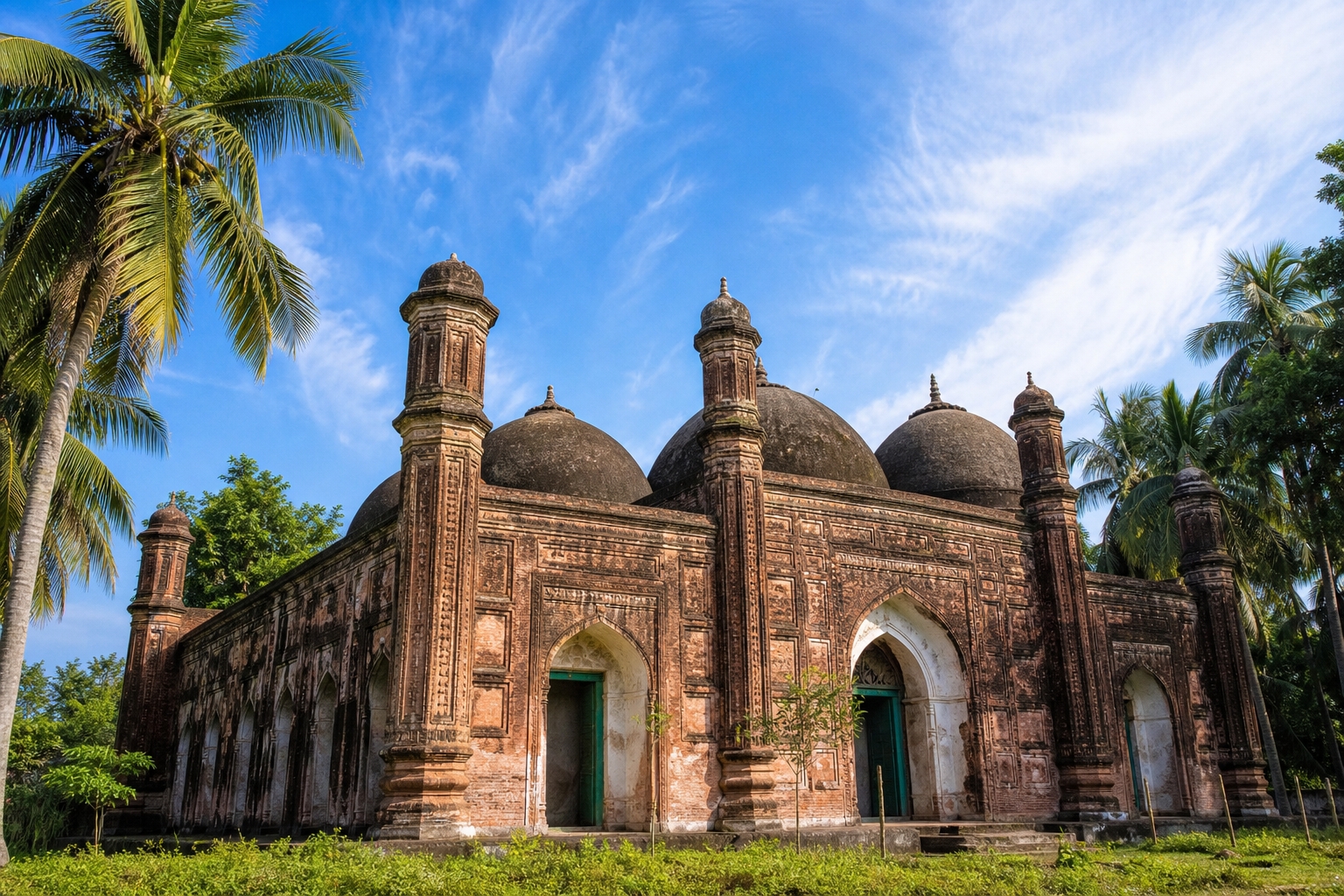
Built in 1723–24, the Katra Mosque (also called Katra Masjid) is the founding monument of Murshidabad — the place where the city's history as a great capital truly begins. Murshid Quli Khan, Bengal's first Nawab, who also served as its greatest economic reformer, commissioned this magnificent structure and chose to be buried beneath its very entrance staircase, a humble gesture of piety that required all who entered to walk over his grave.
The mosque's architectural character is a masterful synthesis of Mughal and Bengali styles. Three large bulbous domes crown the prayer hall, flanked by octagonal corner towers that taper into elegant minarets. The entrance arcade features a series of cusped arches reminiscent of the great mosques of Delhi and Agra, while the brick-and-stucco construction technique reflects the traditions of Bengal's own architectural heritage. Today, the structure has a romantic, ruined quality — its weathered terracotta surface clothed in climbing plants — that makes it one of the most photographed monuments in West Bengal.
The Architectural Splendour of Katra Mosque
Standing within the mosque's inner courtyard — a vast, grass-carpeted rectangle measuring approximately 65 metres by 55 metres — gives a powerful sense of the scale of Murshid Quli Khan's ambitions. The complex originally included a madrasa (Islamic school) that attracted scholars from across the Muslim world; though the madrasa buildings have not survived in their original form, their ruins add to the atmospheric quality of the site.
The four corner towers are among the most distinctive elements of the mosque's silhouette. Rising from octagonal bases, they taper through several diminishing tiers before terminating in slender finials. In the horizontal band connecting them at mid-height runs an inscription in Persian script recording the date of construction and offering praises to Allah and the Prophet. This inscription, though weathered, remains partially legible — a reminder that the mosque's builders intended it to endure for centuries.
Murshid Quli Khan's grave, located directly beneath the main entrance staircase, remains a place of quiet veneration. Local tradition holds that the Nawab chose this unusual location so that all who entered to pray would unknowingly perform an act of honour by stepping above him — a characteristically unconventional expression of Islamic humility. Small offerings of flowers and incense are still left at the grave by pious visitors, maintaining a thread of continuity across three centuries.
Historical Significance
Beyond its architectural merits, the Katra Mosque is historically significant as a monument to Bengal's transition from a Mughal province to an independent Nawabi state. Murshid Quli Khan was a complex figure: a slave of Persian origin who rose through talent and ruthlessness to become the most powerful man in Bengal, transforming its revenue system, encouraging trade, and laying the institutional foundations of the Nawabi state that would last until Plassey in 1757. His mosque stands as the physical embodiment of this remarkable life — grand, weathered, and still commanding attention after 300 years.
Nizamat Imambara (Wasif Manzil)
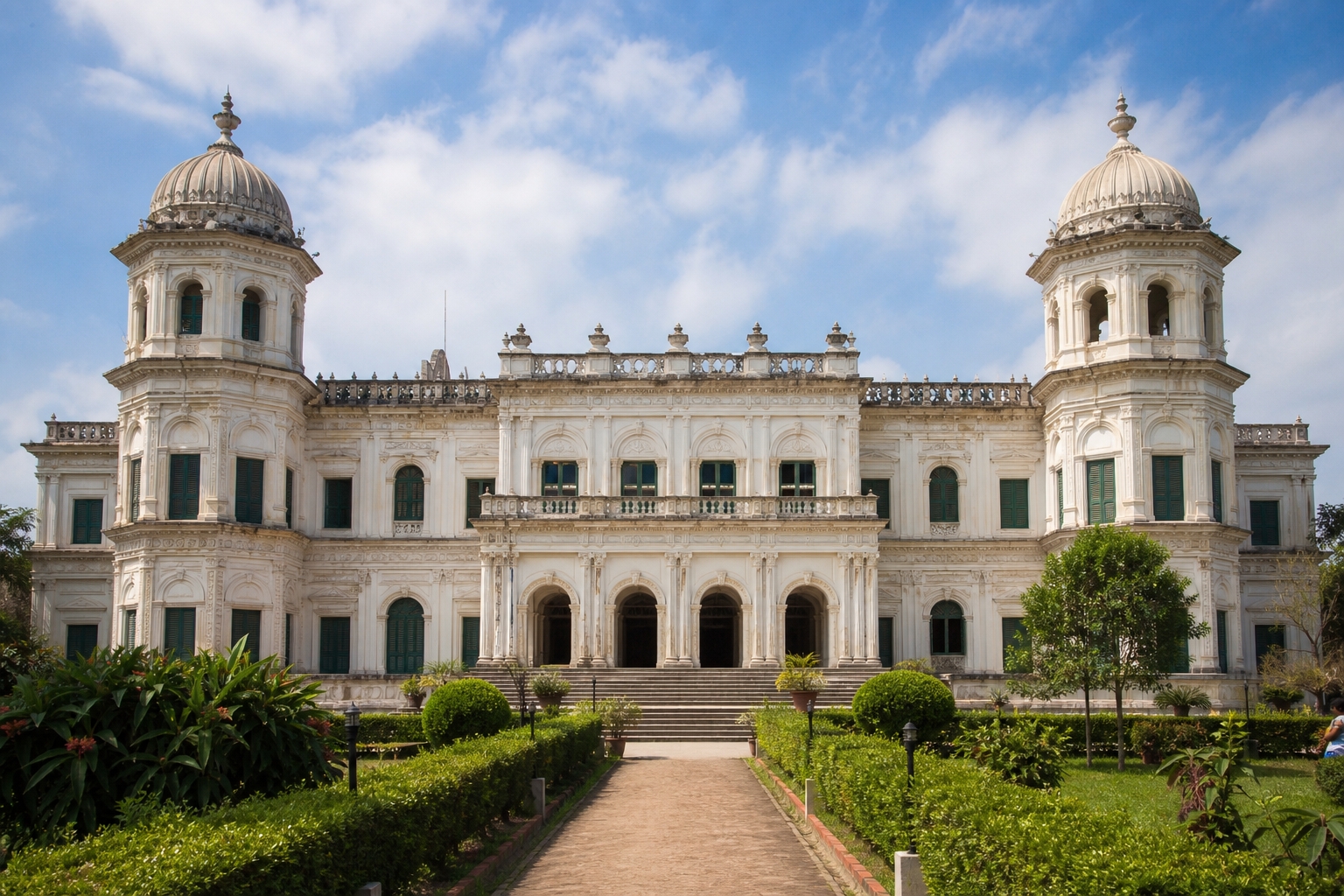
The Nizamat Imambara — formally associated with the adjacent Wasif Manzil palace — is the largest imambara in Bengal and one of the largest in the world, built in 1847 by Nawab Nazim Nazir Ali Khan after the previous imambara was destroyed in a fire. Its construction consumed fabulous resources: the main hall alone measures 68 metres long and 15 metres high, capable of accommodating thousands of worshippers during the Muharram observances.
The imambara's architectural style is a magnificent synthesis — its exterior features a central arched hall flanked by towers with distinctive golden-tipped domes, while its interior is adorned with Belgian and Venetian glass chandeliers, Chinese porcelain lamps, and an elaborate taziya (replica of Imam Hussain's tomb at Karbala) that is the centrepiece of the Muharram procession. The entire complex shimmers with reflected light in a way that is simultaneously spiritual and theatrical.
The Imambara During Muharram
If you have the opportunity to visit Murshidabad during Muharram — the Islamic month of mourning commemorating the martyrdom of Imam Hussain at Karbala — the Nizamat Imambara becomes the focal point of one of India's most remarkable religious observances. The Muharram procession in Murshidabad has been described by 19th-century travellers as among the most spectacular in the subcontinent: vast crowds accompany elaborately decorated taziyas through the streets, accompanied by elegies, drums, and an atmosphere of collective grief that is deeply moving even for non-Muslim observers.
The imambara's interior is specially illuminated for Muharram, and the collection of antique taziyas and relics associated with the commemoration is displayed publicly. This is one of the rare occasions when non-Muslim visitors are permitted to view the interior in its full ceremonial state, making it an extraordinary cultural experience for travellers fortunate enough to time their visit accordingly.
The adjacent Wasif Manzil — the Nawab's palace — is a separate building of considerable elegance, its white facades and twin domed towers visible from a great distance across the flat Murshidabad plain. Though no longer open to the public as a residence, its exterior is accessible and makes for excellent photography, particularly in the warm light of late afternoon.
The Bhagirathi River & Its Ghats
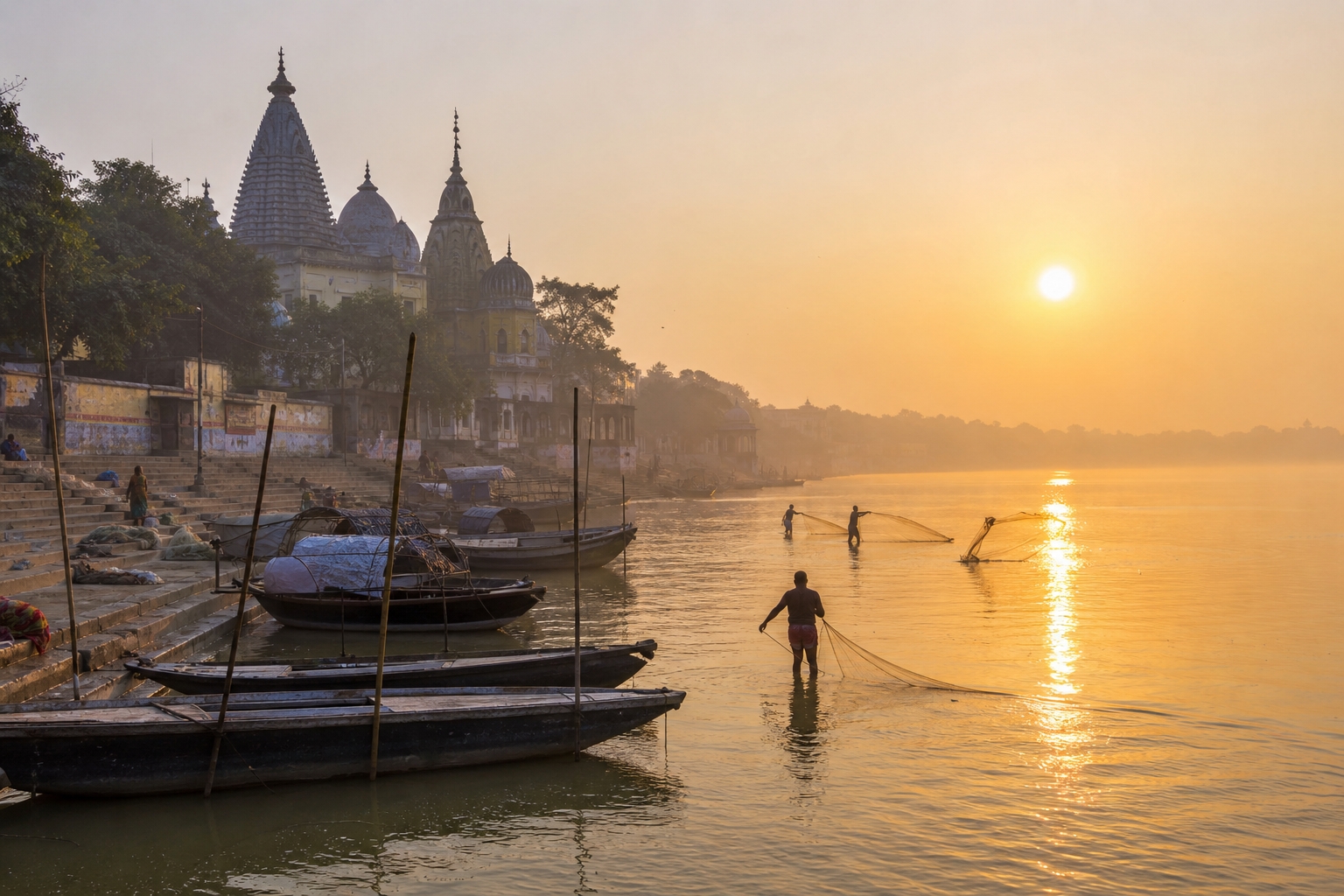
The Bhagirathi River is the physical and spiritual lifeline of Baharampur. This sacred distributary of the Ganges flows along the eastern edge of the city, its ghats (riverside steps) serving as the setting for daily rituals, fishing activities, boat crossings, and some of the most atmospherically beautiful scenes in all of West Bengal.
The ghats of Baharampur and Murshidabad offer experiences that range from the deeply spiritual to the purely aesthetic. At Azimganj Ghat, the old Jain trading community has maintained beautifully decorated temples along the riverside for centuries. At Lalbagh Ghat, the ruins of Nawabi-era structures emerge from the water's edge during the dry season, creating hauntingly beautiful compositions that photographers prize highly. At the Imambara Ghat, the twin towers of the Imambara are reflected in the slow-moving waters of the Bhagirathi in the golden hours around dawn.
Experiencing the Bhagirathi at Its Most Beautiful
Sunrise on the Bhagirathi is one of those travel experiences that is impossible to describe adequately in words. Arriving at the ghat in the pre-dawn darkness, you hear the river before you see it — the lapping of water against stone, the creak of wooden boats, the distant sound of temple bells. As the darkness lifts, the river reveals itself in graduated tones of silver, rose, and gold, with mist rising from the water's surface like incense smoke. Fishermen stand waist-deep in the shallows, casting their nets in graceful, practised arcs that have changed little in centuries.
The ferry crossing from the Baharampur side to Murshidabad town takes approximately 15 minutes and provides a uniquely immersive perspective on the river landscape. From mid-river, with the city receding behind you and the heritage monuments of Murshidabad approaching on the opposite bank — the Imambara towers, the palace roof, the minarets of the Katra Mosque — the full visual grandeur of this heritage landscape becomes apparent in a way that is simply impossible to appreciate from the bank.
Boat rides along the Bhagirathi can be arranged with local boatmen at the main ghat. A typical river tour covers the major ghats, allows close inspection of the Nawabi ruins that emerge from the water during the dry season, and often includes views of rare river dolphins (the Ganges river dolphin, or Susu, is occasionally spotted in this stretch of river, though sightings are increasingly rare). Early morning is the best time for river wildlife, while late afternoon offers the most dramatic photographic light.
More Heritage Sites Near Baharampur
Beyond the headline monuments, the Murshidabad heritage circuit offers many more extraordinary sites for the curious explorer.
Kathgola Palace and Gardens
Kathgola Palace, located in Jiaganj town across the river from Murshidabad, is a stunning example of Indo-European architecture built by the Sett family — wealthy Jain merchants who prospered through the silk trade. The palace's interiors retain much of their original 19th-century furnishing: Italian marble floors, Belgian crystal chandeliers, European oil paintings, and Chinese porcelain vases that reflect the cosmopolitan wealth of the Murshidabad merchant class. The surrounding Italian garden, with its fountains, arbours, and topiary, is one of the most beautiful private gardens in Bengal.
Entry to Kathgola Palace requires advance arrangement with the private trust that maintains it, but the experience is well worth the additional planning. Local guides can facilitate visits. The palace is particularly magical during the winter months when the garden is in full bloom.
Lalbagh Fort Ruins
The Lalbagh Fort, also known as Fort Aurangabad, is an extensive Mughal fortification located on the western bank of the Bhagirathi. Construction was begun by Prince Azam Shah, son of Emperor Aurangzeb, in 1678 but was never completed. Despite — or perhaps because of — its unfinished state, Lalbagh Fort possesses a haunting, romantic quality that makes it one of the most atmospheric heritage sites in the region. Its massive bastions, crumbling gateways, and partially excavated interior spaces hold several monuments within their walls, including the ornate tomb of Pari Bibi ("Lady of the Fairies"), the beloved wife of Shaista Khan.
Pari Bibi's tomb is an architectural gem — a compact octagonal structure faced with white marble and black basalt, decorated with floral inlay work of remarkable delicacy. Local legend holds that Pari Bibi died of grief when Aurangzeb recalled her father Shaista Khan from Bengal, and that her melancholy spirit still wanders the fort at night — a story that adds an appropriately romantic dimension to any after-dusk visit (though the fort officially closes at sunset).
Kiriteswari Temple
Approximately 28 kilometres north of Baharampur lies the Kiriteswari Temple — one of the 51 Shakti Pithas (sacred seats of the goddess Shakti) of the Hindu tradition, and among the most significant pilgrimage destinations in West Bengal. According to the Puranic myth, when the grief-stricken god Shiva carried the corpse of his consort Sati across the universe, fragments of her body fell at various locations; at Kiriteswari, it is said that her crown (kirita) fell. The current temple structure, though rebuilt in its present form in the 18th century, stands on a site of immemorial antiquity.
The Kiriteswari temple complex is a lively, atmospheric place where the rhythms of Hindu devotional life play out continuously. The smell of incense, the sound of bells and chanted mantras, the sight of pilgrims from across Bengal making offerings of flowers and sweets — all create an immersive cultural experience that complements the Islamic and colonial heritage of the Murshidabad circuit beautifully. The approach to the temple, through rural Bengal's rice paddies and mustard fields, is itself a pleasure.
Berhampore Cantonment Heritage Walk
For those interested in the colonial period of Baharampur's history, a walking tour of the old cantonment area offers considerable interest. The British established a significant military presence here from the 1760s onwards, and the cantonment retains substantial evidence of this period: St. John's Church (1832), built in the distinctive Bengal Presidency Gothic style; the Officers' Mess, a handsome white-columned building still in military use; the old Jail Road lined with mature trees; and several Victorian bungalows — some inhabited, some decaying — set in large compounds that preserve the spacious character of the colonial settlement.
The cantonment also holds an important place in the history of the 1857 Rebellion. It was at Berhampore that the 19th Native Infantry first refused to accept the controversial Enfield cartridges in February 1857, in a protest that foreshadowed the great uprising two months later. A small monument near the old parade ground marks this historically significant act of resistance.
Plassey Battlefield Memorial
No visit to the Murshidabad heritage circuit is truly complete without a pilgrimage to the site of the Battle of Plassey (1757), approximately 40 kilometres north of Baharampur. The battlefield itself is now largely agricultural land — mango groves and rice paddies — but a small memorial erected by the ASI marks the spot where one of the most consequential battles in world history took place on 23 June 1757. The simplicity of the memorial, set among peaceful rural surroundings, lends it a solemnity that more elaborate monuments often lack.
The journey to Plassey passes through the rural heartland of Murshidabad district — a landscape of extraordinary beauty in winter, when mustard fields turn the countryside brilliant yellow and the air carries a mild, pleasant chill. A visit to Plassey combines naturally with a stop at the Jafargunj Cemetery in Murshidabad town, where several of the principal figures of the Nawabi period are buried, including Mir Jafar — the general whose treachery handed Bengal to the British East India Company.
Jiaganj and Azimganj: The Twin Towns of Silk
Located directly across the Bhagirathi from Murshidabad town, the twin municipalities of Jiaganj and Azimganj represent a different chapter of the region's history — one written by the Jain merchant community rather than the Muslim Nawabs. During the 18th and 19th centuries, wealthy Jain trading families (known as the Seths or Setts) accumulated extraordinary fortunes through the silk trade, money-lending, and banking, using their wealth to construct magnificent havelis (courtyard houses), ornate Jain temples, and fine gardens along the Bhagirathi's western bank.
Today, Jiaganj-Azimganj is a tranquil backwater whose extraordinary architectural heritage is only beginning to attract the attention it deserves. The Baj Baj Ghat area contains a remarkable concentration of early 19th-century Jain temples, their white marble facades decorated with mirror-work, stained glass, and carved stone panels. Several havelis have been opened to visitors by their current owners, offering a fascinating glimpse into the domestic architecture of Bengal's Jain merchant elite. The weaving quarters adjacent to these towns are also worth visiting — this is where much of the Murshidabad silk saree production continues today.
Suggested Itineraries for Baharampur
Whether you have one day or a full week, here's how to make the most of your Murshidabad heritage experience.
One-Day Heritage Highlights
Morning (6 AM – 12 PM): Begin at the Bhagirathi ghats for sunrise (6–7 AM). Take the river ferry to Murshidabad town (7:30 AM). Visit the Katra Mosque (8–9 AM) before the heat builds. Proceed to Hazarduari Palace (9:30 AM – 12 PM), allowing 2.5 hours for the museum.
Afternoon (12 – 5 PM): Lunch at a local restaurant near the palace complex — try fish thali or kachoris. Visit the Nizamat Imambara (2–3:30 PM). Return by ferry to Baharampur (4 PM). Evening walk along the Baharampur ghat and visit local sweet shops for mishti doi.
This compact itinerary covers the four headline attractions and is entirely feasible in a single day from Kolkata (though staying overnight in Baharampur adds immeasurably to the experience).
Three-Day Immersive Circuit
Day 1: Baharampur arrival, ghat sunrise, cantonment heritage walk, evening market and sweet-shop tour.
Day 2: Full Murshidabad heritage day — Katra Mosque, Hazarduari Palace, Nizamat Imambara, Jafargunj Cemetery, Kathgola Palace.
Day 3: Jiaganj-Azimganj silk town tour, Kiriteswari Temple, drive to Plassey battlefield memorial, return to Baharampur.
Five-Day Cultural Deep Dive
Day 1: Arrive in Baharampur. Rest, ghat walk, evening at local market.
Day 2: Murshidabad town — all main heritage sites.
Day 3: Jiaganj-Azimganj silk route — weavers, temples, havelis.
Day 4: Plassey battlefield, Kiriteswari Temple, river boat excursion.
Day 5: Cooking class or silk dyeing workshop, shopping for silk sarees, departure.
Photography Enthusiast Schedule
For photographers, the Murshidabad circuit is a paradise of light and texture. Key recommendations:
- Bhagirathi ghats: Arrive 30 minutes before sunrise; stay until 90 minutes after.
- Katra Mosque: Best light from 8–10 AM (eastern light on the domes).
- Hazarduari Palace: Overcast days reveal the building's architectural details without harsh shadows.
- Imambara: Late afternoon (4–5 PM) when the golden domes catch the low western sun.
- Jiaganj havelis: Early morning for side-lit architectural details.
Ready to Experience Baharampur's Culture & Food?
Beyond the monuments lies a living culture of festivals, music, handcrafts, and extraordinary cuisine. Continue exploring.