A Culture Woven from Silk, Song & Centuries of Syncretic Heritage

Baharampur's cultural identity is one of the most fascinating in all of India — a living synthesis of Islamic, Hindu, and colonial influences that have coexisted, intermingled, and enriched one another over three centuries. Here, Durga Puja pandals rise alongside Muharram processions; the Baul mystic-poet sings in a language that moves seamlessly between Sanskrit devotional vocabulary and Sufi Persian metaphor; and a Bengali Hindu woman wraps herself in a Murshidabad katan silk saree woven by a Muslim artisan whose technique traces back to the workshops of Mughal court weavers.

This syncretic character — rooted in shared geography, shared commerce, and shared generations of daily life — is Baharampur's most profound cultural gift to the visitor. It cannot be fully appreciated in a single day or distilled into a single exhibit. It reveals itself gradually, in small moments: in the way a sweet-shop owner slips naturally between Bengali, Urdu, and Hindi; in the Muslim calligrapher who also paints Hindu devotional images for local customers; in the crowd that gathers equally around a Baul musician performing at a village fair, regardless of the listeners' religious backgrounds.

This page is your guide to experiencing Baharampur's culture and cuisine as deeply and authentically as possible — from the world-famous silk workshops to the festival calendar, from the street-food trail to the evening ghat rituals that mark the rhythms of this river city's daily life.

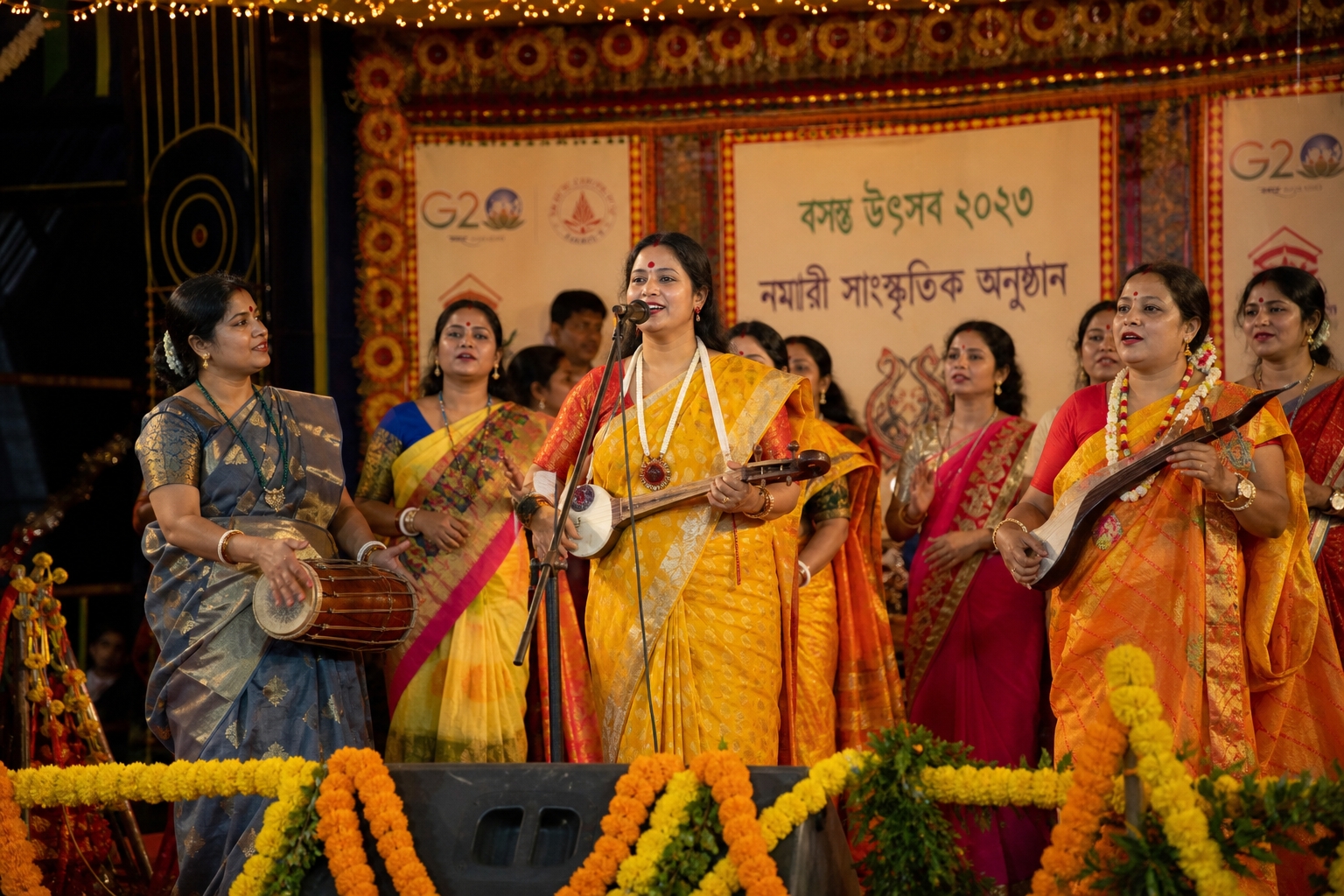
Women in vibrant silk sarees performing traditional Baul music with a dotara and khol drum on a marigold-decorated festival stage
Traditional Baul performance at a Bengali cultural festival, Baharampur

Murshidabad Silk: The Fabric of Royalty

For over 300 years, the weavers of Murshidabad have produced silk of incomparable beauty — draped by Nawabs and sought by collectors worldwide.

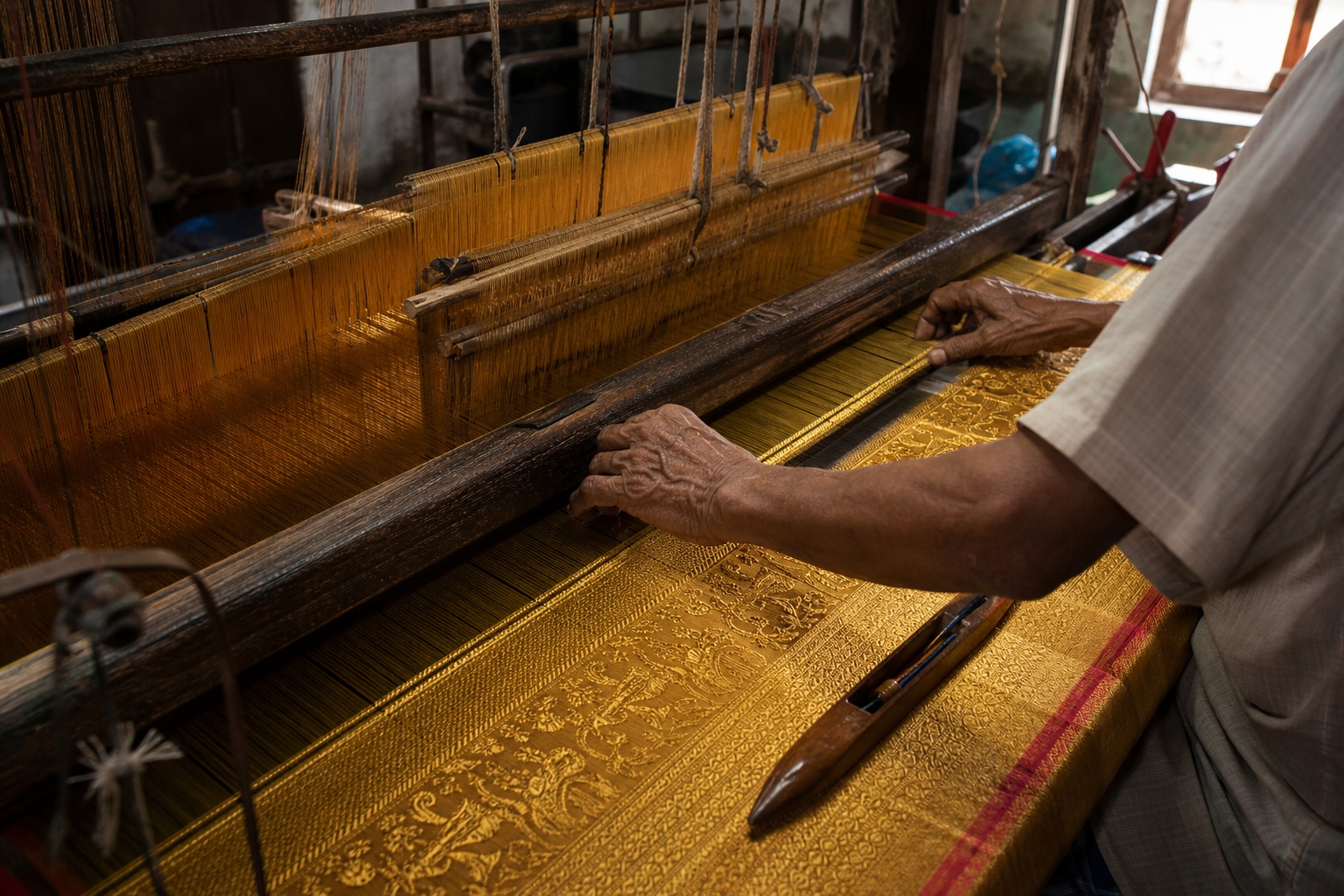
An elderly master weaver in Murshidabad operating a traditional wooden handloom, weaving golden silk with intricate floral patterns
A master weaver creating a traditional Murshidabad silk saree on a handloom

The History of Murshidabad Silk

The silk industry of Murshidabad is among the oldest continuously operating craft traditions in South Asia. Sericulture — the cultivation of silkworms for silk production — has been practised in the Murshidabad region since at least the 14th century, and the quality of Bengali silk was noted by Chinese travellers and Arab merchants in medieval accounts. However, it was during the Nawabi period of the 18th century that Murshidabad silk reached the pinnacle of its prestige and technical refinement.

Murshid Quli Khan and his successors were lavish patrons of the silk industry, employing hundreds of master weavers (ustads) in court workshops and distributing their output as diplomatic gifts to Mughal emperors, European trading companies, and foreign dignitaries. The most prized product was katan silk — a closely woven fabric of pure raw silk with a characteristic lustre and weight that distinguished it from all other Indian silks. Katan silk sarees were worn by the Nawabs' wives and daughters, and their production involved techniques of exceptional complexity that could only be mastered after years of apprenticeship.

The silk industry contracted severely after the Battle of Plassey (1757) and the subsequent decline of Nawabi patronage, but it never entirely disappeared. The weaving families of Jiaganj, Azimganj, and the villages surrounding Murshidabad continued their craft through lean generations, preserving techniques that might otherwise have been lost. Today, after decades of government support and growing consumer appreciation for handloom textiles, Murshidabad silk is experiencing a remarkable revival.

Murshidabad Silk Today: A GI-Tagged Heritage Craft

Murshidabad silk received Geographical Indication (GI) protection from the Government of India in 2013 — a recognition that the specific combination of local raw silk, weaving techniques, and regional traditions creates a product of unique character that cannot be authentically replicated elsewhere. The GI tag also provides legal protection against imitations sold under the Murshidabad name, helping genuine weavers receive fair prices for their labour.

Approximately 12,000 weavers are estimated to be actively engaged in silk production in the Murshidabad district, the majority concentrated in the Jiaganj-Azimganj area and the villages immediately surrounding Murshidabad town. The typical weaving household operates one or two pit looms or frame looms, with the entire family participating in various stages of production: the women commonly handle thread reeling and preparation, while the men operate the looms for the technically demanding weaving process itself.

A high-quality Murshidabad katan silk saree takes between three days and two weeks to complete, depending on the complexity of the design. The most intricate pieces — featuring fine zari (gold or silver thread) work, jamdani-style supplementary weft patterns, or elaborate butis (small repeating motifs) — may require a master weaver's full attention for a month. Such pieces can command prices of ₹20,000–₹1,00,000 or more in urban boutiques; visiting a weaver directly and purchasing at source typically offers prices 30–50% lower.

Visiting the Silk Weaving Villages

The most authentic way to experience Murshidabad silk is to visit the weaving villages directly. The area around Jiaganj on the western bank of the Bhagirathi offers the easiest access for visitors staying in Baharampur: a short ferry crossing followed by a cycle-rickshaw ride brings you to workshops where you can watch the entire production process at close quarters.

Most weavers are welcoming of visitors, particularly those who come with evident genuine interest in the craft rather than merely as buyers. Taking time to watch a weaver work — to observe the precise, rhythmic movements of hands, feet, and body as the loom is operated — is genuinely rewarding, even for those with no intention of purchasing. The sound of a handloom in operation is itself memorable: a rhythmic, percussive sound like a drumbeat, punctuated by the softer whisper of the shuttle passing through the warp threads.

Silk dyeing workshops are particularly fascinating. Natural dyes — derived from indigo, turmeric, pomegranate skin, and iron-rich water — produce colours of extraordinary depth and subtlety that synthetic dyes cannot fully replicate. Some traditional dyers in the Murshidabad area still use these natural processes, though chemical dyes have largely replaced them for mass production. Workshops using natural dyeing techniques are worth seeking out specifically, as they represent a layer of the craft tradition that is genuinely endangered.

The Murshidabad Silk Weavers Association and the West Bengal Handloom Board both maintain offices in Baharampur and can provide information about reputable weavers, current silk exhibitions, and forthcoming craft fairs. The annual Murshidabad Silk Festival, held in winter, brings together weavers from across the district in a celebration that includes live demonstrations, competitions, and the opportunity to purchase directly from hundreds of weavers simultaneously.

What to Buy: A Silk Shopping Guide

For first-time buyers, navigating the silk market can be overwhelming. Here are the key product categories to know:

  • Katan Silk Sarees: The flagship product — pure raw silk, tightly woven, with a distinctive weight and drape. Look for the GI tag and certificate of authenticity.
  • Baluchari Sarees: A related tradition from Bishnupur using silk to narrate mythological stories in the border and pallu (end piece). Technically demanding and highly collectible.
  • Silk Dupattas and Stoles: More affordable entry point; excellent gifts. Look for pieces with hand-embroidered borders.
  • Silk Kurta Fabric: Sold by the metre; ideal for custom tailoring. Remarkable range of colours and weights available.
  • Zari Work Accessories: Clutch bags, decorative panels, and small items featuring the same gold-thread work used in fine sarees.
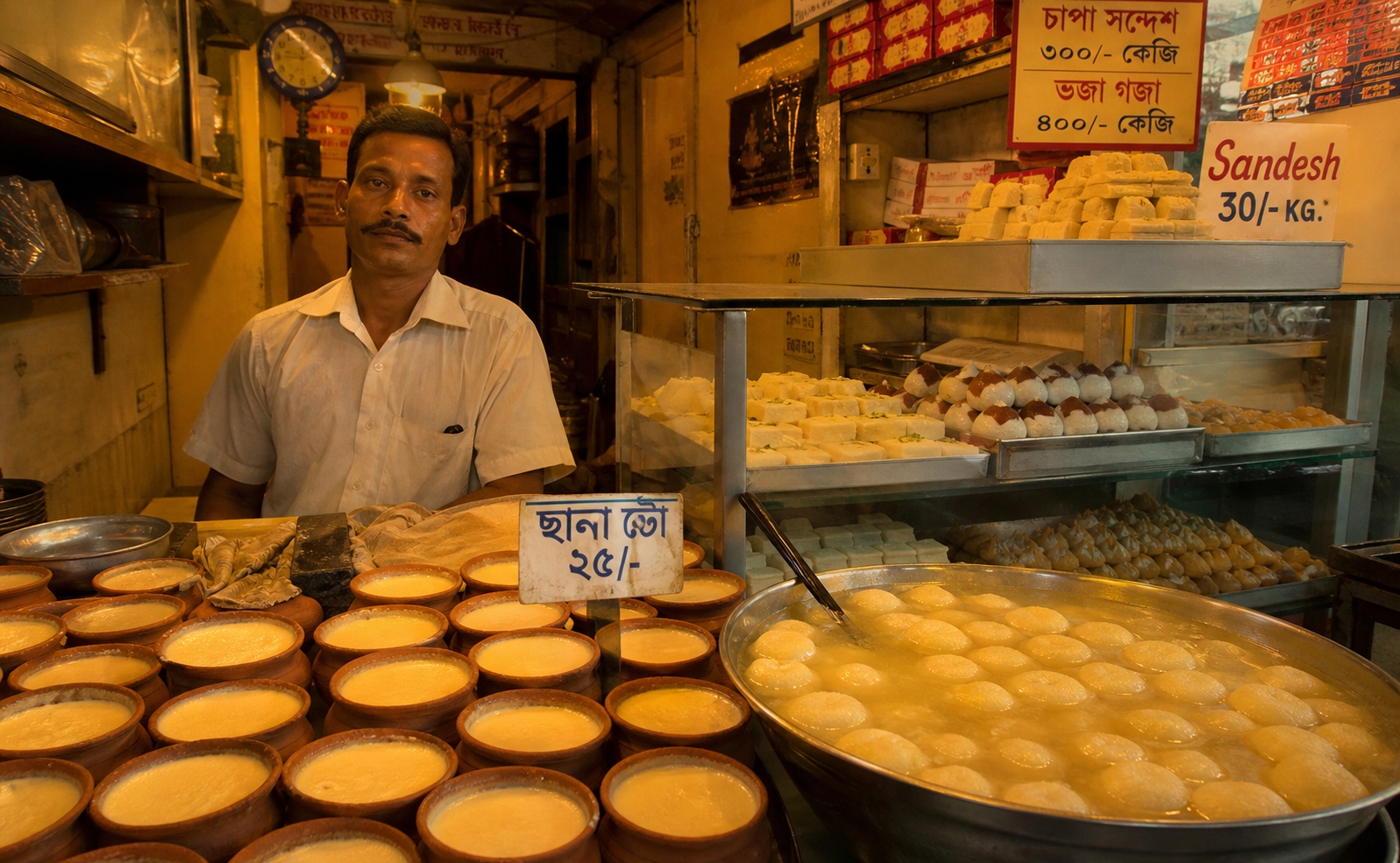
A vibrant Bengali sweet shop counter in Baharampur with clay pots of mishti doi, rosogolla in syrup and sandesh on display
A traditional Bengali sweet shop in Baharampur, home of mishti doi and rosogolla

The Flavours of Baharampur: A Bengali Gastronomy Guide

Bengali cuisine ranks among the world's great culinary traditions — and Baharampur is one of its finest laboratories. Here's everything you need to eat, drink, and savour.

Bengali cuisine is a study in contrasts and subtleties that rewards patience and an adventurous palate. Unlike the predominantly spice-forward cuisines of much of India, the Bengali kitchen prizes the nuanced interplay of mustard, poppy seed, coconut, and a unique "panch phoron" (five-spice blend) that creates dishes of extraordinary aromatic complexity. The cuisine is also unusual in its sophisticated use of bitter vegetables, its elaborate system of course sequencing at formal meals, and its passionate relationship with freshwater fish — an obsession that borders on the philosophical.

Baharampur's food culture adds additional layers to this rich tradition. The city's Muslim community has contributed centuries of Nawabi culinary influence: biryanis perfumed with saffron and kewra water, kormas enriched with cashew and cream, and an entire tradition of refined meat cookery that reflects the Nawabs' Persian cultural heritage. The result is a local food scene of remarkable richness, where a single street might offer both a family sweet shop whose mishti doi recipe has been unchanged for five generations and a restaurant serving biryani from a technique originally taught by cooks from the Nawab's kitchen.

🐟 Hilsa Fish Curry (Ilish Macher Jhol)

The hilsa — called ilish in Bengali — is not merely a fish but a cultural icon, the subject of poetry, the centrepiece of festivals, and the dish that every Bengali dreams of during the monsoon season when the fish run upriver. Hilsa caught in the Bhagirathi and Padma rivers are considered the finest in the world, their flesh uniquely rich, oily, and full of flavour due to the specific mineral content of these rivers. A freshly caught Bhagirathi hilsa, steamed with mustard paste and green chillies in a banana-leaf parcel, is a transcendent culinary experience that food writers have compared favourably with the finest dishes anywhere in Asia.

🍯 Mishti Doi (Sweetened Fermented Yogurt)

Mishti doi — literally "sweet curd" — is perhaps Baharampur's most iconic food product, the confection that best captures the city's character: simple in form, extraordinary in execution, and deeply satisfying. Made by thickening whole milk, sweetening it with date palm jaggery or sugar, and then fermenting it slowly in unglazed earthen pots (bhar), mishti doi has a texture that is simultaneously silky and slightly grainy, a flavour that balances sweetness with a subtle fermented tang, and a colour ranging from pale cream to deep caramel depending on the caramelisation of the sugar. The earthen pot is not merely a container but an active participant in the recipe — its porous walls allow slow evaporation that concentrates the flavour and creates the characteristic slight dryness around the edges.

🌿 Mustard Prawn Curry (Chingri Macher Malai Curry)

Prawns — particularly the large freshwater prawns (golda chingri) that inhabit the Bhagirathi and its tributaries — are the second great obsession of the Bengali kitchen, rivalling even the hilsa in the devotion they inspire. The classic preparation in Baharampur is a mustard-paste curry: the prawns marinated briefly in turmeric and salt, then cooked in a sauce of freshly ground yellow mustard, coconut, and green chillies, finished with a generous splash of mustard oil and served with steamed white rice. The result is a dish of startling pungency and aromatic complexity that encapsulates everything distinctive about the Bengali culinary aesthetic.

🍬 Sandesh & Rosogolla

Bengal's confectionery tradition is among the world's most sophisticated, and Baharampur's sweet shops represent the living apex of this tradition. Sandesh — made from freshly curdled chenna (a type of cottage cheese) kneaded with sugar and flavoured with cardamom, saffron, or rose water — comes in dozens of local varieties, each sweet shop guarding its distinctive recipe with fierce pride. Rosogolla — spongy balls of chenna soaked in light sugar syrup — was originally a Bengali invention, and the version served in Baharampur's old sweet shops, using full-fat cow's milk, has a flavour and texture that bears little resemblance to the commercial product familiar to most Indians.

🥘 Murshidabad Mutton Biryani

The Nawabi legacy is nowhere more deliciously present than in Baharampur's biryani tradition. The Murshidabad-style biryani is distinguished from its Kolkata cousin by a greater emphasis on the meat (typically whole pieces of bone-in mutton rather than the fried potatoes that Kolkata biryani is famous for) and a more restrained use of food colouring, allowing the natural saffron hue to predominate. The rice — long-grain gobindobhog or basmati — is cooked separately and then layered with the meat and its cooking juices in a sealed vessel (dam) for a slow, fragrant final cooking that allows the flavours to meld completely. The best Murshidabad biryanis are found in the older Muslim neighbourhoods of the city, in restaurants that have been operating from the same location for generations.

🥗 Posto (Poppy Seed Dishes)

Bengal's relationship with posto (poppy seeds) is unique in Indian cuisine — these tiny seeds, ground into a paste, form the base of a remarkable range of dishes that have no parallel elsewhere. Aloo posto (potatoes cooked in poppy seed paste with green chillies) is perhaps the quintessential Bengali comfort food: simple, aromatic, and deeply satisfying. The version served in Baharampur uses locally grown poppy seeds that have a distinctive nutty depth, and the cooking technique — a slow dry roast of the paste before the potatoes are added — creates a texture and flavour that is quite different from the rushed versions common in urban Bengali restaurants.

Where to Eat in Baharampur: A Local's Guide

Baharampur's best food is not found in formal restaurants but in the informal establishments — known as "hotels" in the local dialect — that line the main market streets and cluster around the bus stand and railway station. These places typically serve a fixed daily menu (thali) of rice, dal, two or three vegetable preparations, fish curry, and chutney for a price of ₹80–150 per person. The quality of these simple meals, produced with locally sourced ingredients and cooked fresh each day, consistently outperforms that of more elaborate and expensive establishments.

For mishti doi and sweets, the old sweet shops around Baharampur's central market area — some of them dating back to the late 19th century — are the essential destinations. Look for shops that still use traditional clay stoves (chulha) for cooking and earthen pots for setting the doi; these are the establishments most likely to be following traditional recipes with minimal shortcuts.

Street food in Baharampur is excellent and available from early morning to late evening. Breakfast staples include luchi (deep-fried wheat puffbread) with cholar dal (split chickpea curry), kachori-singara (fried pastry with spiced filling), and muri (puffed rice) eaten with mustard oil and shredded onion. Evening street food includes jhal muri (spiced puffed rice with tamarind and green chillies), telebhaja (various vegetable fritters), and — in winter — thick, sweet thickened milk (rabri) served warm from roadside stalls.

For those interested in Nawabi cuisine, several restaurants in the older Muslim quarters of the city serve traditional preparations: korma, rezala (a white, cream-based meat curry with whole spices), shami kebab, and the distinctive Murshidabad biryani. These establishments typically open for lunch (12–3 PM) and dinner (7–10 PM), and reservations are rarely necessary except during Eid and local festivals when demand surges dramatically.

Festivals & Cultural Events in Baharampur

Baharampur's festival calendar spans the religious traditions of three great civilisations — every season brings a new reason to celebrate.

Perhaps no aspect of Baharampur's cultural life better illustrates its syncretic character than its festival calendar. The city celebrates with equal enthusiasm across the Hindu, Islamic, and Bengali secular traditions, and many festivals have evolved their own uniquely local forms that differ markedly from how they are observed elsewhere in India. Understanding these festivals — their origins, their local variations, and the best way for visitors to respectfully participate — is essential preparation for any visit.

Festival Season / Month Tradition Key Experience
Durga Puja October (Autumn) Hindu / Bengali Elaborate pandals, community feasts, dhak drumming, artistic installations
Muharram Islamic calendar (varies) Islamic / Shia Grand taziya procession from Nizamat Imambara; solemnly beautiful
Eid ul-Fitr Islamic calendar (varies) Islamic City-wide celebration; exceptional street food, markets, communal prayers
Kali Puja October/November (Diwali night) Hindu / Bengali Night-time worship with dramatic fireworks and temple illuminations
Saraswati Puja January/February Hindu / Bengali Students worship the goddess of learning; educational institutions celebrate
Poila Boishakh April 14–15 Bengali New Year Processions, new clothes, visiting sweet shops, cultural performances
Murshidabad Silk Festival November/December Cultural / Heritage Direct purchase from weavers; demonstrations; cultural performances
Baul Mela Winter (December–January) Folk / Sufi Multi-day gathering of Baul musicians; all-night performances
Kiriteswari Fair March (Chaitra month) Hindu pilgrimage Large temple fair with traditional vendors, folk performances, devotion

Durga Puja: Baharampur's Greatest Celebration

Durga Puja — the five-day festival honouring the goddess Durga that falls in October each year — is the emotional and cultural high point of the Bengali year, and Baharampur celebrates it with a fervour that must be witnessed to be believed. Unlike the mega-commercial spectacle of Kolkata's famous pandals, Baharampur's Durga Puja retains a more intimate, community-centred character in most neighbourhoods — though the grander installations in the city centre can rival anything seen in larger cities for ambition and artistry.

Each neighbourhood (para) constructs its own pandal — a temporary structure, often of extraordinary architectural or artistic sophistication, housing the image of the goddess and her family. The competition between para committees for the most impressive pandal is intense; months of planning, fundraising, and construction culminate in the four-day public display. Themes range from reproductions of famous world monuments to abstract artistic installations to elaborate recreations of historical Bengal.

The social dimension of Durga Puja is inseparable from its religious significance. The festival is an occasion for new clothes, family reunions, community feasting, and the kind of joyful, exhausting social whirl that defines the Bengali character at its most exuberant. Visitors are almost invariably welcomed into pandals and offered prasad (blessed food); the atmosphere of goodwill and openness that characterises the festival makes it perhaps the ideal time for first-time visitors to Baharampur to experience the city's true hospitality.

Baul Music: Bengal's Living Mystical Tradition

The Baul tradition — a syncretic folk-spiritual movement that blends elements of Sufism, Vaishnavism, and Tantric philosophy — is one of Bengal's most distinctive cultural contributions to world heritage, recognised by UNESCO as an Intangible Cultural Heritage of Humanity in 2008. Baul musicians (Bauls) travel the countryside as wandering minstrels, composing and performing songs of ecstatic spiritual longing in a style that uses deceptively simple language to encode profound philosophical ideas.

Murshidabad district, with its deeply syncretic religious character, is a particularly rich territory for Baul culture. The Baul tradition draws on both the Islamic Sufi concept of divine love (ishq) and the Hindu Vaishnava concept of devotion (bhakti), and in a region where these two traditions have coexisted for centuries, the synthesis feels entirely natural. Many of the most celebrated Baul composers and performers have come from the Murshidabad area, and the tradition remains vibrantly alive in village gatherings, religious fairs, and dedicated Baul melas (festivals).

For the visitor, the most accessible way to experience authentic Baul performance is at one of the regular melas held at various locations across the district. The annual Baul Mela held near Baharampur in December-January typically spans three or four nights, with performances beginning in the evening and continuing until dawn. Sitting on the ground beneath an open sky, surrounded by a crowd of hundreds, listening to a Baul singer pour out his heart to the accompaniment of the dotara (two-stringed folk instrument) and ektara (one-stringed instrument), is one of the most purely musical experiences available in India.

Muharram: A Festival of Profound Beauty and Mourning

The Muharram observances in Murshidabad and Baharampur are among the most significant in West Bengal, drawing both Muslim participants and curious visitors from across the region. The ten-day commemoration of the martyrdom of Imam Hussain at the Battle of Karbala (680 CE) culminates in a grand procession on the tenth day (Ashura) that is both deeply moving and visually spectacular.

The procession begins at the Nizamat Imambara and winds through the main streets of Murshidabad town, accompanied by taziyas of extraordinary artisanal elaboration — miniature reproductions of the shrine at Karbala, built from bamboo, tinfoil, coloured paper, and cloth into structures several metres tall, carried on the shoulders of groups of young men. The procession is accompanied by the sound of dirges (elegies called marsiya or noha), drums, and the rhythmic striking of chests (matam) by mourners. The combination of grief, devotion, communal solidarity, and visual spectacle is unlike anything else in Indian cultural life.

Visitors attending Muharram in Baharampur are advised to dress modestly, maintain a respectful demeanour, and refrain from photography near the Imambara during the most intense moments of the commemoration. Most locals are welcoming of respectful observers, and the experience offers a profound insight into the depth of religious culture that underpins Baharampur's syncretic identity.
Handicrafts & Living Arts of Baharampur

Beyond silk weaving, Baharampur and Murshidabad sustain a remarkable range of traditional craft traditions that are worth seeking out.

Murshidabad Ivory Carving

Murshidabad was historically famous for ivory carving of exceptional quality — the city's master craftsmen produced miniature replicas of the Hazarduari Palace, intricate jewellery boxes, and devotional images of such technical refinement that they were sought by collectors across Asia and Europe. Following the international ban on ivory trade under CITES, the craft has largely transitioned to alternative materials — bone, wood, and synthetic materials — though the techniques of the ivory-carving tradition are preserved in a small number of families who now apply them to legally permissible materials.

Several artisans in Baharampur continue to produce work in the ivory-carving aesthetic using bone and hardwood, creating pieces of considerable beauty that make excellent souvenirs. The Archaeological Survey of India's craft emporium near Hazarduari Palace stocks some of this work at reasonable prices, with certification of authenticity.

Bell Metal and Dokra Metalwork

The Dokra tradition — ancient lost-wax casting of figures in bell metal — is practised across rural West Bengal, and Murshidabad district has its own distinctive local variant. Dokra pieces from this region typically feature figures from Hindu mythology, animals, and ritual objects, cast in a characteristically rough, textured style that gives them an archaic, folk-art quality quite different from the refined metalwork of the palace tradition. Dokra craftspeople can be found in villages north of Baharampur, and their workshops are often open to visitors who come with curiosity and respect.

Kantha Embroidery

Kantha — the traditional quilted embroidery of Bengal, created by layering worn cotton saris and stitching them together with a simple running stitch to create images of extraordinary complexity — is practised widely across Murshidabad district. The motifs favoured by Murshidabad kantha workers reflect the region's syncretic character: lotus flowers alongside arabesque patterns, Hindu deities alongside Islamic geometric designs, European-influenced floral borders enclosing scenes from Bengali folk tales.

Contemporary kantha stoles, cushion covers, and kurta fabrics featuring traditional Murshidabad motifs are available in the craft shops of Baharampur's central market area. Prices range from ₹300 for a simple kantha-stitch handkerchief to ₹15,000 or more for a large, intricately worked kantha quilt in a traditional design. Women's self-help groups affiliated with various NGOs in the district sell kantha work directly from small shops and market stalls, and purchasing from these outlets ensures that the craftswoman receives the largest possible share of the sale price.

Terracotta Temple Art

The terracotta temple tradition of Bengal — in which entire temple facades are covered with narrative relief panels depicting scenes from the Ramayana, Mahabharata, and Puranic mythology — is most famously associated with nearby Bishnupur, but excellent examples also exist within the Murshidabad circuit. The terracotta temples at Baranagar (on the western bank of the Bhagirathi, a short distance from Baharampur) are among the finest examples of this tradition: small, exquisitely decorated 18th-century structures whose brick facades are covered with panels of remarkable vitality and narrative richness.

A day trip to Baranagar, combining the temple visit with a boat journey along the Bhagirathi, is an excellent addition to any Baharampur itinerary. The village itself is quiet and atmospheric, with several temples in various states of preservation; the most elaborate of them has been partially restored and is accessible to visitors throughout the day.

"To eat in Baharampur is to understand Bengali culture — the mishti doi is a philosophy, the hilsa is a religion, and the biryani is history itself made edible."
— A celebrated Bengali food writer on the cuisine of Murshidabad

Cultural Etiquette & Practical Advice

Dressing for the Cultural Context

Baharampur's mixed religious character means that dress codes vary significantly between locations. At Hindu temples, modest dress (covered shoulders and knees) is appreciated; at mosques and the Imambara, it is strictly required for all visitors, and women should carry a scarf to cover their head inside the prayer hall. The Bhagirathi ghats and market areas have no formal dress code, though visitors who dress respectfully (avoiding sleeveless tops and very short shorts) will find that local interactions are warmer and more genuine.

In the weaving villages, visitors who dress in locally appropriate attire — traditional Indian garments, or simply modest Western clothing — are received more warmly than those who arrive in touristic attire. This is not a formal requirement but a matter of cultural sensitivity that makes a palpable difference to the quality of the interactions you will have.

Language and Communication

The primary language of Baharampur is Bengali, with a significant proportion of the population also speaking Urdu (in the Muslim neighbourhoods) and Hindi (widely understood for commercial purposes). English is spoken at hotels, major tourist sites, and by educated residents, but is rarely heard in market areas, weaving workshops, or local food establishments.

Learning a handful of basic Bengali phrases — "namaskar" (hello, Hindu greeting), "assalamu alaikum" (hello, Islamic greeting), "dhonyobaad" (thank you), and "koto taka?" (how much?) — will earn you immediate goodwill and open doors that remain firmly closed to visitors who arrive with no knowledge of the local language. A translation app on your phone is a useful backup, though the pronunciation of Bengali can be challenging for non-speakers.

Photography Culture and Etiquette

Photography is a sensitive subject in Baharampur, as in many historically significant Indian cities. While the monuments themselves generally welcome photography (within the guidelines specific to each site), photographing people — particularly women, worshippers at religious sites, and people in moments of vulnerability or privacy — requires explicit permission and should be sought respectfully.

Weaving workshops are generally happy to be photographed, especially if you express genuine interest in the craft and spend time engaging with the artisan before reaching for your camera. Starting with a conversation and asking permission ("amar ki photo tulte parbo?" — "may I take a photograph?") invariably produces a warmer response and often results in better photographs.

Supporting Local Culture

The most meaningful contribution a visitor can make to Baharampur's cultural landscape is to support local artisans, performers, and food producers directly. Purchasing silk from weavers rather than wholesale dealers, eating at family-run local restaurants rather than hotel dining rooms, attending and making a small donation at Baul performances, and hiring local guides rather than city-based tour operators — all of these choices ensure that the economic benefits of tourism circulate within the community that sustains the culture you have come to experience.

Several community-based tourism initiatives in Baharampur connect travellers directly with artisan families, cultural practitioners, and local guides in ways that are mutually beneficial. The district tourism office in Baharampur can provide current information about these programmes, which tend to offer excellent value alongside genuine cultural exchange.

Ready to Explore Baharampur's Monuments?

Now that you know Baharampur's culture and cuisine, discover the extraordinary heritage sites that make this one of India's greatest travel destinations.